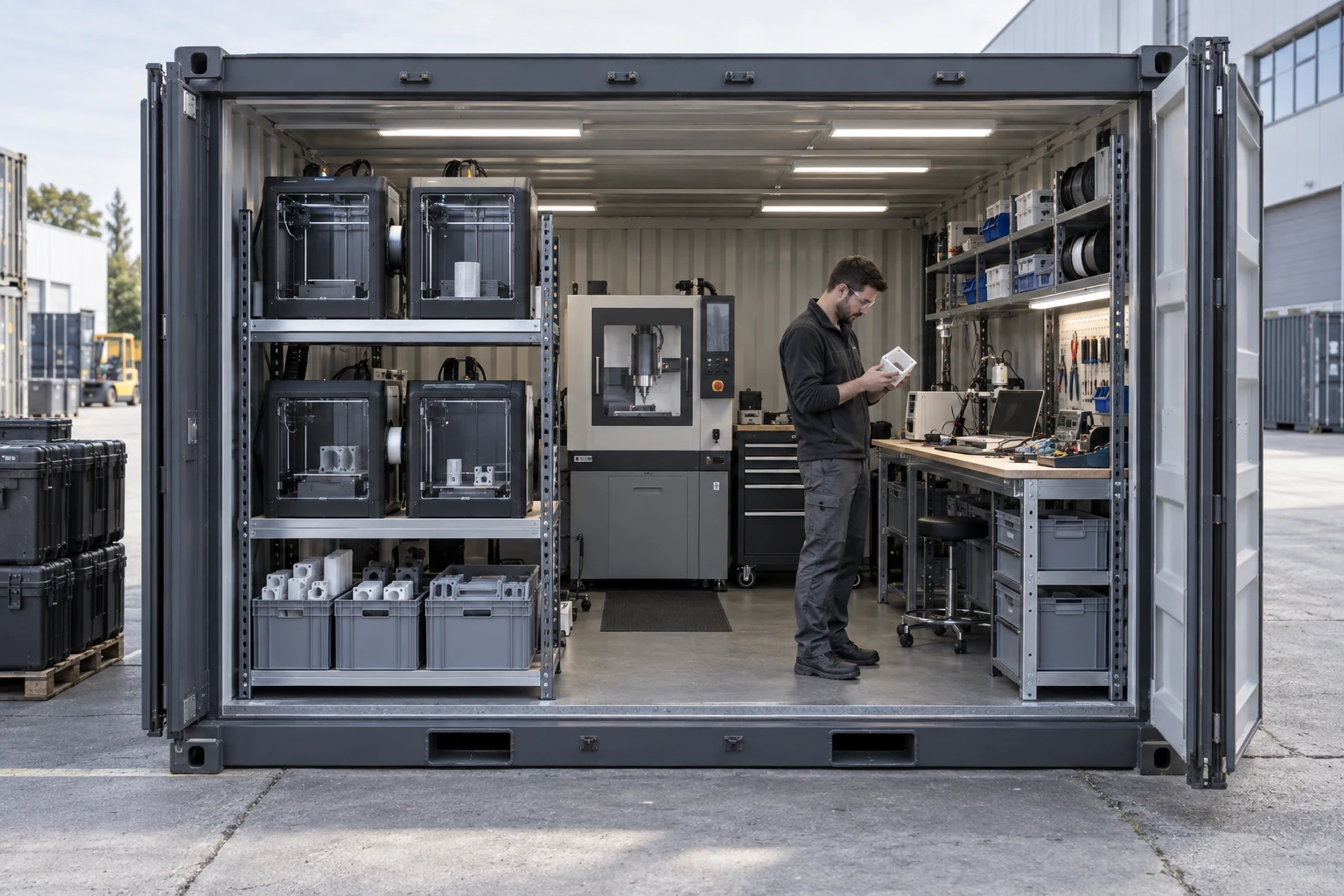
Deployable fabrication workshops
Equipment that changes frequently also needs a way to make updated parts, assemble new units and repair existing ones. We are considering compact workshops that could perform selected production and repair tasks closer to deployed teams.
The equipment would depend on the job: printers for some parts, machining or moulding for others, and workstations for assembly and testing. Possible applications include drone components and repeatable first-person-view (FPV) drone assembly.
We would want these workshops to produce repeatable batches, but their capacity depends on more than their machines. It needs component supply, power, trained operators, documented builds and quality checks. The first step would be to choose a representative assembly and measure the time, materials and labour needed to produce it consistently.
Authorised perimeter evaluation
Infrastructure operators need to know whether the systems they have bought detect the drone activity they are concerned about. We are considering a service that would test a perimeter with representative drones under an agreed, authorised trial plan.
The output would be a report on observed coverage, missed detections and false alarms, with the test conditions recorded. If we evaluate our own equipment, we would make that relationship explicit and agree the test conditions and reporting with the operator beforehand. Results could then inform further development.
Other ideas from the lab
We are also retaining a few less-developed ideas for future assessment. These are outside the current development effort.
- Environmental sensing
- Reuse suitable power, communications and sensor software in conservation monitoring. Field requirements would determine which parts actually transfer.
- Decoys
- Assess affordable decoys for protecting scarce equipment. Supplier claims about signatures and effectiveness would need independent testing.
- Aerostat-based platforms
- Investigate whether lighter-than-air carriers have a useful role. Payload, weather tolerance and operating economics need to be understood before an integrated platform is justified.
- Civil preparedness
- Explore continuity planning and exercises with infrastructure operators and local authorities, where a specific gap in preparedness can be identified.
How we would choose the next project
A project needs a prospective user, a requirement we can test and a plausible route to manufacture or delivery. We would also ask how much existing engineering it can reuse. Those questions should keep the lab’s breadth from becoming a collection of unrelated prototypes.
Discuss a proposed project